What’s the Difference Between Raw Honey and Regular Honey?
After years of tending bees in the Tasmanian highlands, I’ve learned that honey is far more complex than most people realise. The difference between what you find in a supermarket jar and what we produce at Frogmouth Ponds comes down to one crucial decision: temperature. In this post, I’ll walk you through exactly what raw honey is, how it differs from commercial honey, and why our cold-extraction process preserves the flavours and nutrients that make Tasmanian honey truly special.
What Is Raw Honey?
Raw honey is honey that hasn’t been heated above approximately 45°C during extraction, processing, or bottling. This low-temperature approach preserves the delicate compounds that give honey its remarkable properties: enzymes, pollen, antioxidants, and volatile aromatic compounds that contribute to flavour and aroma.
When I’m harvesting honey from the frames, the bees have already done the hard work. They’ve collected nectar, added enzymes, evaporated excess moisture, and sealed the honeycomb with propolis. The honey at that stage is essentially complete—alive, if you will, with beneficial enzymes and intact crystalline structures.
The term “raw” doesn’t mean unfiltered or unprocessed in the way some people assume. Most raw honeys, including ours, are gently filtered to remove large bee debris. What it means is that we don’t expose the honey to high temperatures, and we don’t ultra-filter it to the point where we remove the pollen and fine particles that give honey its character.
How Is Commercial Honey Processed?
To understand raw honey, it helps to understand what happens to the vast majority of honey sold in supermarkets. Commercial honey production is optimised for shelf stability, clarity, and ease of processing—not for nutritional value or flavour.
Most commercial honey is heated to 70°C or higher during pasteurisation. At this temperature, the heat kills any yeast cells that might cause fermentation, but it also destroys many of the heat-sensitive enzymes. Diastase, one of the key enzymes present in raw honey, is particularly vulnerable. Studies have shown that pasteurised honey loses up to 30% of its diastase activity.
After heating, commercial honey is often ultra-filtered. This process forces honey through extremely fine filters to remove all pollen, bee proteins, and other particles. The honey becomes perfectly clear and flows smoothly, but you’re essentially removing the very compounds that make honey distinctive. Pollen grains carry flavour compounds and are a marker of the honey’s floral origin. Remove them, and you’ve removed the honey’s fingerprint.
Ultra-filtering also serves another purpose: it masks the origin of the honey. Blended supermarket honey often comes from multiple sources across different countries, and removing pollen makes it impossible to trace. This is why commercial honey often tastes generic and why there’s so little connection between the jar and the place it came from.
| Property | Raw / Cold-Extracted Honey | Commercial / Processed Honey |
|---|---|---|
| Processing method | Gently extracted, cloth-filtered | Pasteurised at 70°C+, ultra-filtered |
| Temperature exposure | Never above ~45°C | Heated to 70–80°C during pasteurisation |
| Pollen & enzymes | Intact — full enzyme activity preserved | Largely destroyed or removed by ultra-filtering |
| Nutritional value | Higher — antioxidants, vitamins, minerals retained | Reduced — heat degrades sensitive compounds |
| Flavour profile | Complex, floral-specific, varies by harvest | Generic, uniform, blended for consistency |
| Crystallisation | Natural — will crystallise over time (sign of quality) | Delayed — pasteurisation slows crystallisation |
| Traceability | Single-origin, pollen identifies floral source | Often blended from multiple countries, untraceable |
What Does Cold-Extracted Mean?
Cold extraction is the cornerstone of what we do at Frogmouth Ponds. It means that at no point during harvesting, extraction, or bottling does the honey exceed approximately 45°C. We achieve this through deliberate choices at every stage.
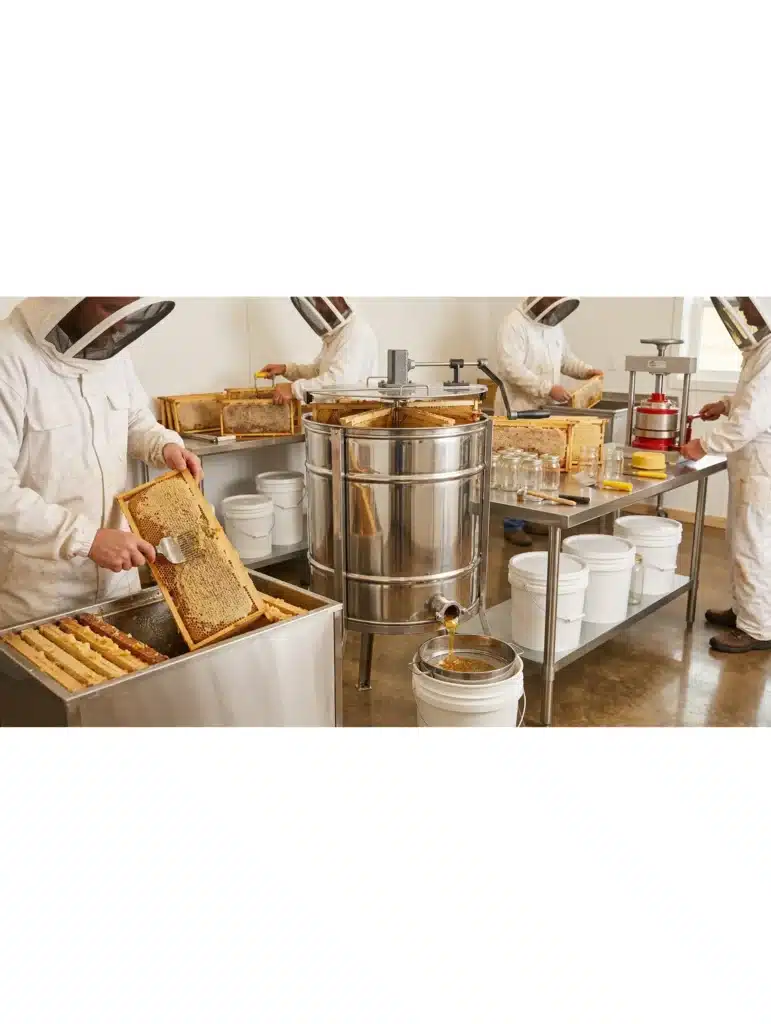
First, we harvest during the cooler parts of the day. We use an uncapping knife that we keep at a consistent temperature. When we extract using our radial extractor, we work in a temperature-controlled space. We don’t spin the honey out quickly (which generates heat through friction); instead, we use gentle, slow extraction. We filter gently through cloth rather than force-filtering through micron screens.
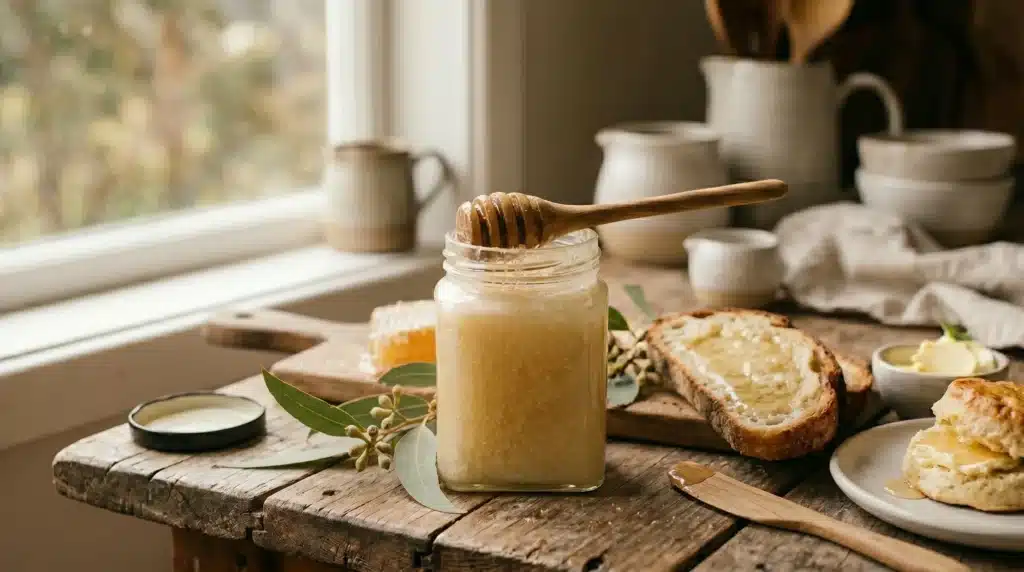
Crucially, we never blend honey for shelf appearance. If a batch crystallises, we don’t heat it to liquify it again. We leave it as it is, or we educate customers on the beauty of crystallised honey—which, by the way, is far easier to portion and actually easier to use in cooking than liquid honey.
The result is honey that still contains the full complement of enzymes, including invertase and amylase, which aid digestion. It contains intact pollen grains that tell the story of the flowers the bees visited. It contains the volatile aromatic compounds that make a good honey smell and taste like something specific, not like generic “honey flavour.”
“Heating honey above 45°C is like taking a photograph and copying it a dozen times — each copy loses fidelity. Cold extraction preserves the original.”
Why Tasmanian Raw Honey Is Different
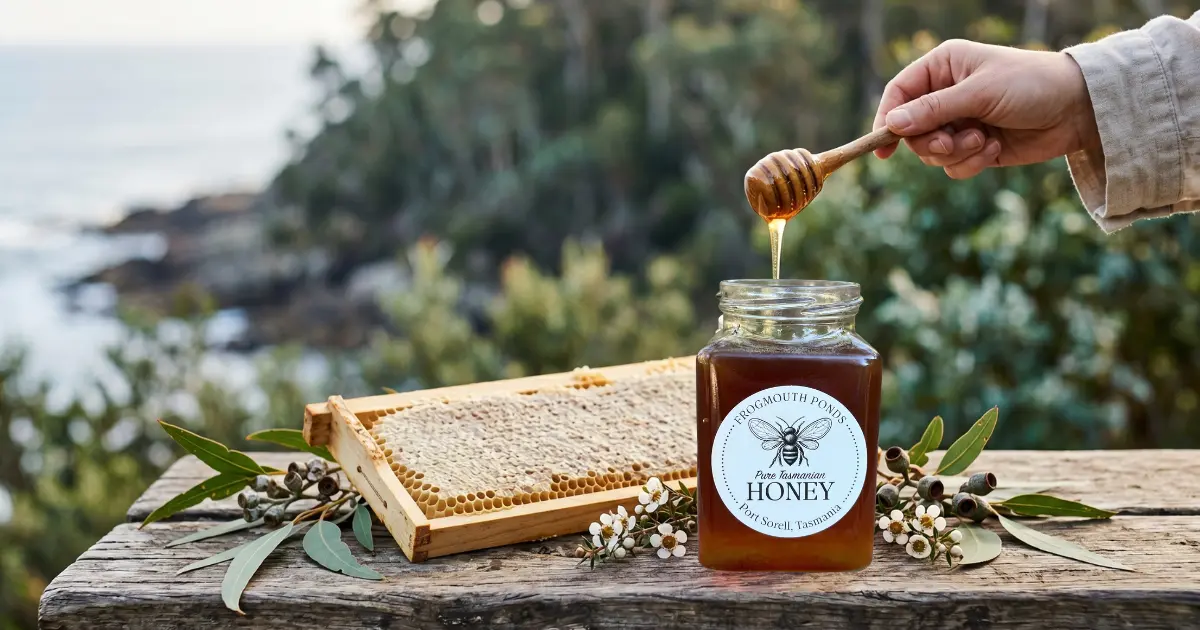
Tasmania’s geography and climate create honey that’s genuinely distinct from mainland Australian honey. Our apiary is based in Port Sorell, on Tasmania’s north-west coast, where the landscape is dominated by native forests and wild flowering plants.
The most celebrated variety we produce is Leatherwood honey. Leatherwood trees are ancient, slow-growing, and they don’t flower reliably every year. When they do, it’s typically every 3–5 years, and it only lasts for about 6 weeks. Some Leatherwood trees take over 100 years to flower for the first time. The honey is amber to dark amber, intensely aromatic, and has a buttery, almost savory quality. It’s recognised internationally as one of the world’s rarest and most prized honeys.
But Leatherwood isn’t the only story in Tasmanian honey. Our Blue Gum honey, produced from the flowers of eucalyptus forests, is lighter and floral with subtle spice notes. Our Clover honey is delicate and subtly sweet. Our Blackberry honey has an almost wine-like complexity.
What ties all of these together is place. Tasmania’s clean air, cool climate, and absence of industrial-scale agriculture mean that our honey isn’t competing with monoculture and pesticide drift. There are no megafarms nearby poisoning the floral landscape. The island’s isolation is a gift to our bees.
And when I say “our honey,” I mean it. Because we cold-extract and because we don’t blend, you’re tasting honey from specific forests, in specific seasons, from specific hives. You’re not tasting a product designed to be identical year on year. You’re tasting a place and a moment in time.
Which Frogmouth Ponds Honey Is Right for You?
We produce six varieties, each cold-extracted and traceable to our apiary. Every jar is packaged in glass and includes information about its floral source, extraction date, and provenance.
Our Cold-Extracted Honey Range
Six varieties. Single-origin. Traceable to our apiary in Port Sorell, Tasmania.
All of our honey is available at our online shop. You’ll know exactly what you’re buying.
Frequently Asked Questions
Is raw honey safe to eat?
Absolutely, for adults and children over 12 months old. Infants under 12 months should not consume honey of any kind (raw or processed), as their digestive systems aren’t mature enough to handle spores of Clostridium botulinum. For everyone else, raw honey is safe and has been safely consumed for thousands of years. In fact, raw honey’s natural acidity and antimicrobial properties make it one of the safest foods we can eat.
Why does raw honey crystallise?
Crystallisation is a natural and inevitable process in raw honey, and it’s actually a sign of quality. Honey crystallises when glucose (which raw honey contains in higher proportions) forms solid crystals over time. Different honeys crystallise at different rates depending on their glucose-fructose ratio, but all honeys will eventually crystallise unless they’re heated above certain temperatures. Some people prefer crystallised honey because it’s easier to portion, and crystallisation doesn’t change the honey’s nutritional value or safety. If you prefer liquid honey, simply place the jar in warm water (not hot—we want to keep it below 45°C) and let it gently warm.
What does cold-extracted mean exactly?
Cold-extracted means the honey is never heated above approximately 45°C during any stage of production—from extraction through to bottling. This is important because heat destroys enzymes (particularly diastase), volatile aromatic compounds, and can damage heat-sensitive antioxidants. Cold extraction preserves all of these beneficial compounds, which is why cold-extracted honey tastes more flavourful and retains more of its nutritional character than heated honey.
Is Tasmanian honey really different from mainland Australian honey?
Yes, genuinely. Tasmania’s unique flora, isolated island environment, and cool climate produce honey with distinct flavour profiles and floral sources not found on the mainland. Leatherwood, our signature variety, grows only in Tasmania and is one of the world’s most prized honeys. Our Blue Gum, Blackberry, and Clover varieties also reflect Tasmania’s specific landscape. Add to that our commitment to small-batch, cold-extracted production, and you have honey that’s genuinely different from the blended, heat-processed honey you’ll find in most supermarkets.
How should I store raw honey?
Store honey at room temperature in a sealed glass jar, away from direct sunlight. Honey is hygroscopic, meaning it attracts moisture from the air, so keep the lid on tight. You don’t need to refrigerate it. A sealed jar of honey will keep indefinitely—honey is one of the few foods that doesn’t go bad. If it crystallises, that’s fine; you can use it as is or gently warm it in warm water to liquify it again.
Cold-Extracted Tasmanian Honey
Single-origin, traceable honey from our apiary in Port Sorell. Each variety tells the story of Tasmania’s unique landscape and our commitment to artisan production. Discover the flavours that commercial honey can’t offer.
Shop Our Honey Range