Raw Tasmanian Honey — What It Is and Why It Matters
Most honey sold in supermarkets has been heated, filtered, and processed until the interesting parts are gone. Here’s what raw honey actually is — and why Tasmanian raw honey is worth seeking out.
Walk into any supermarket and the honey shelf looks impressive — dozens of varieties, every price point, every brand. But read the labels carefully and you’ll find the same thing almost everywhere: “Honey.” No origin, no process description, no indication of what happened between the hive and the jar.
What usually happened is this: the honey was heated to above 70°C to make it flow easily through industrial equipment, ultra-filtered to remove pollen and any particles that might cause crystallisation, and blended from multiple sources — often including imported honey — to hit a consistent flavour profile and price point.
The result is a product that looks like honey, tastes vaguely of honey, and has a very long shelf life. But it’s missing almost everything that made the original interesting.
Raw honey is different. Here’s what that actually means.
What Raw Honey Actually Is
Raw honey is honey that has been extracted from the comb without being subjected to high heat, and bottled with minimal processing. It retains the natural enzymes, pollens, waxes, and aromatic compounds that exist in honey as the bees produced it.
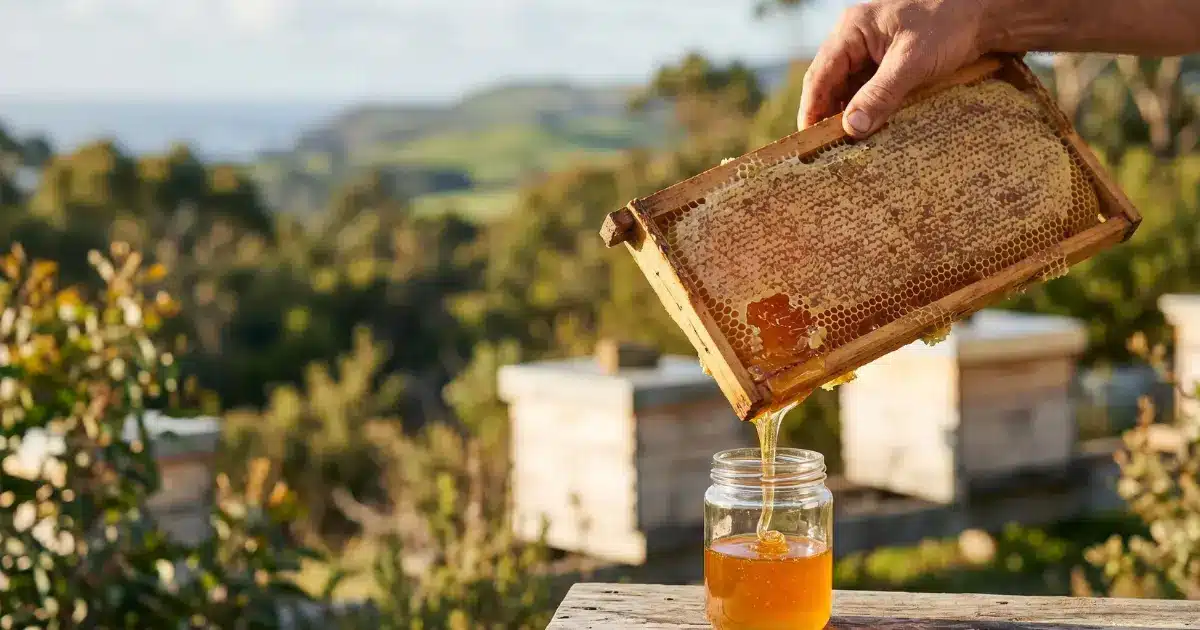
There’s no legal definition of “raw honey” in Australia, which means the term is used loosely by some producers. At Frogmouth Ponds, our honey is cold-extracted — meaning it is never heated above the natural temperature of the hive (approximately 35°C). It is lightly filtered to remove wax and debris but retains its natural pollen content. Nothing is added, nothing is blended with offshore honey, and nothing is removed to extend shelf life.
“Cold extraction preserves the volatile aromatic compounds that give each variety its distinctive flavour. Heat doesn’t just kill enzymes — it drives off the fragile molecules that make Leatherwood smell like Leatherwood.”
Raw vs Processed: What the Difference Looks Like
| Property | Commercial processed honey | Raw cold-extracted honey |
|---|---|---|
| Heat treatment | Heated 60–80°C for bottling | Never exceeds hive temperature (~35°C) |
| Natural enzymes | Significantly reduced or destroyed | Fully preserved |
| Pollen content | Removed by ultra-filtration | Naturally present |
| Aromatic compounds | Driven off by heat | Intact — full varietal flavour |
| Crystallisation | Suppressed — stays liquid | Natural — a sign of quality |
| Origin | Often blended, may include imports | Single origin, single producer |
Why Tasmanian Raw Honey Is Different
Tasmania’s geographic isolation has protected it from many of the pressures affecting mainland beekeeping — Varroa mite arrived in New South Wales in 2022 and has spread significantly, but Tasmania maintains strict biosecurity controls. This means Tasmanian bees are, as a population, healthier than most — and healthy bees produce better honey.
Beyond biosecurity, Tasmania’s landscape offers something increasingly rare in Australia: diverse, relatively undamaged native flora. The island’s endemic species — most famously the Leatherwood tree of the southwest wilderness — produce nectar with compounds that exist nowhere else on earth. Even more common species like Blue Gum and Clover produce honey with a Tasmanian character that reflects the island’s clean air, intact soils, and lower pesticide load compared to heavily farmed mainland regions.
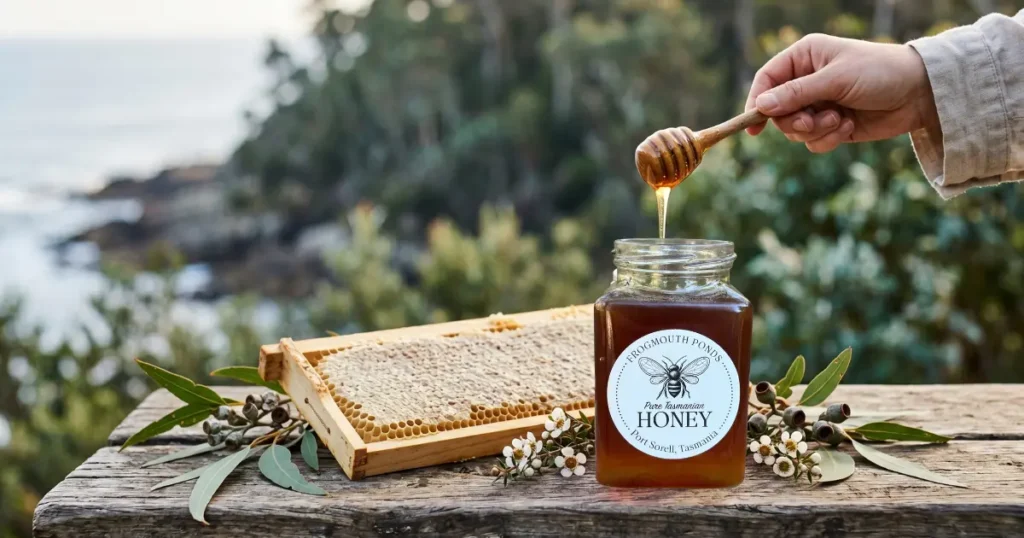
Cold extract that honey and bottle it at source — as we do at our Port Sorell apiary — and you have a product that genuinely captures a place. That’s what makes Tasmanian raw honey worth buying from a small producer rather than a shelf.
Why Honey Crystallises — and Why That’s Good News
One of the most common questions we get: why has my honey gone solid?
Crystallisation is a natural process that happens to all real honey over time. Glucose — one of honey’s primary sugars — forms crystals when the honey cools or sits undisturbed. The speed of crystallisation varies by variety: Clover crystallises quickly into a soft white spread, while Leatherwood, with its higher fructose content, stays liquid much longer.
Commercial honey doesn’t crystallise because it’s been ultra-filtered and heated — processes that remove the pollen particles that act as crystallisation seeds and destroy the natural enzymes that facilitate the process. A honey that never crystallises has usually been processed to the point where it behaves more like sugar syrup than real honey.
If your raw honey has crystallised, it’s easy to return it to liquid: place the jar in warm (not hot) water — around 40°C — and leave it for 30 minutes. Never microwave honey or place it in boiling water. High heat destroys the very enzymes and aromatic compounds that make raw honey worth buying in the first place.
How to Buy Raw Tasmanian Honey
When buying raw honey, look for these signals:
- Named origin: The honey should tell you where it came from — not just “Product of Australia” but a specific region or producer
- Cold-extracted or raw labelling: With the caveat that these terms are unregulated, a producer who uses them should be able to tell you exactly what they mean by it
- Natural crystallisation: Either as a feature (the honey is already set) or as an acknowledged possibility on the label
- Pollen content: Pollen is naturally present in unfiltered honey and is one of the markers that lets lab testing verify origin
- Small batch: Volume and quality are in tension in honey production. Small producers who manage their own hives are more likely to be able to guarantee what they’re telling you
At Frogmouth Ponds, we manage our own hives at two apiary sites on Tasmania’s north-west coast — Port Sorell and Acacia Hills. We cold-extract each variety ourselves, bottle on-site, and can trace every jar to a specific harvest. That traceability is part of what raw means to us.
Frequently Asked Questions
Is your honey really raw?
Yes. We cold-extract all our honey — it is never heated above the natural hive temperature of approximately 35°C. We lightly filter to remove wax and large particles but do not ultra-filter, and we do not add anything. What’s in the jar is exactly what the bees made.
Can I buy raw Tasmanian honey online?
Yes — we ship all varieties Australia-wide (except Western Australia and the Northern Territory due to biosecurity regulations). Orders are processed from our Port Sorell apiary and shipped in glass jars.
How is cold-extracted honey different from raw honey?
Cold extraction is a specific process — the honey is spun out of the comb without any added heat. “Raw” is a broader term that generally means unheated and minimally processed. Our honey is both raw and cold-extracted, which is the highest standard of minimal processing.
How long does raw honey last?
Honey is one of the few foods that doesn’t spoil. Archaeological honey thousands of years old has been found still edible. The natural acidity, low moisture content, and hydrogen peroxide activity of real honey make it inhospitable to bacteria. Store in a cool, dry place away from direct sunlight and your honey will last indefinitely.
Which raw Tasmanian honey should I try first?
If you want something versatile and approachable, start with our Clover honey. If you want to experience what makes Tasmanian honey genuinely unique, Leatherwood is the answer. Our 190g taster size is a great way to try a variety before committing to a larger jar.
Shop Our Raw Tasmanian Honey
Cold-extracted at our Port Sorell apiary. Single-origin, never blended, never heated.
Order Raw Tasmanian Honey Direct
From our hives to your table. No blending, no heat, no shortcuts.
Taste the difference for yourself
Every jar is cold-extracted by hand from our apiaries across Tasmania’s wilderness. Try Leatherwood, Clover or Blue Gum and find your favourite.
Shop Honey →