From the Apiary · April 2026
Why We Use Tasmanian Beeswax
In Every Lip Balm We Make
Most lip balms are built on petroleum. Ours aren’t. Here’s what we use instead — and why it makes all the difference.
By Stewart Harry · Frogmouth Ponds, Port Sorell · 6 min read
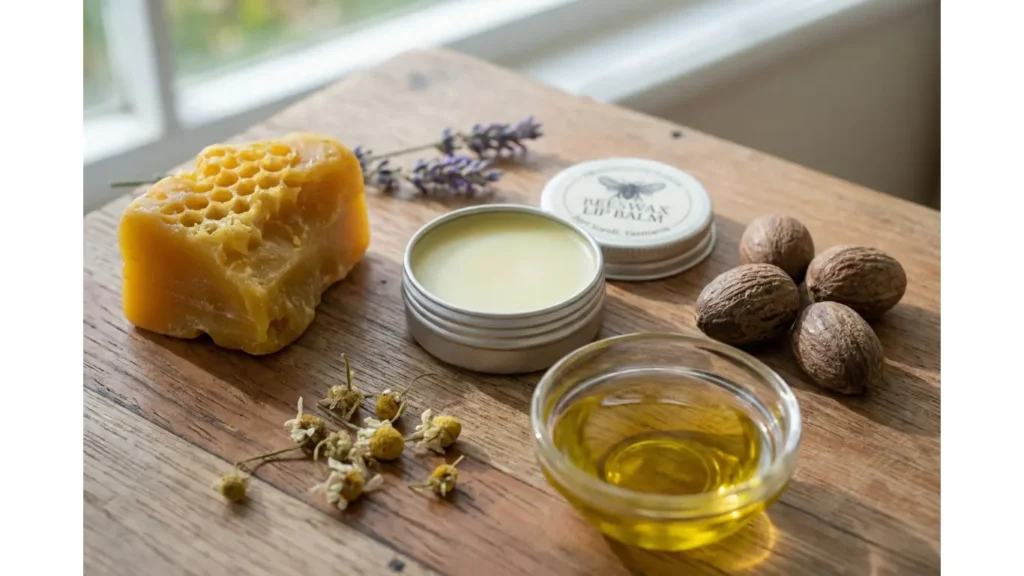
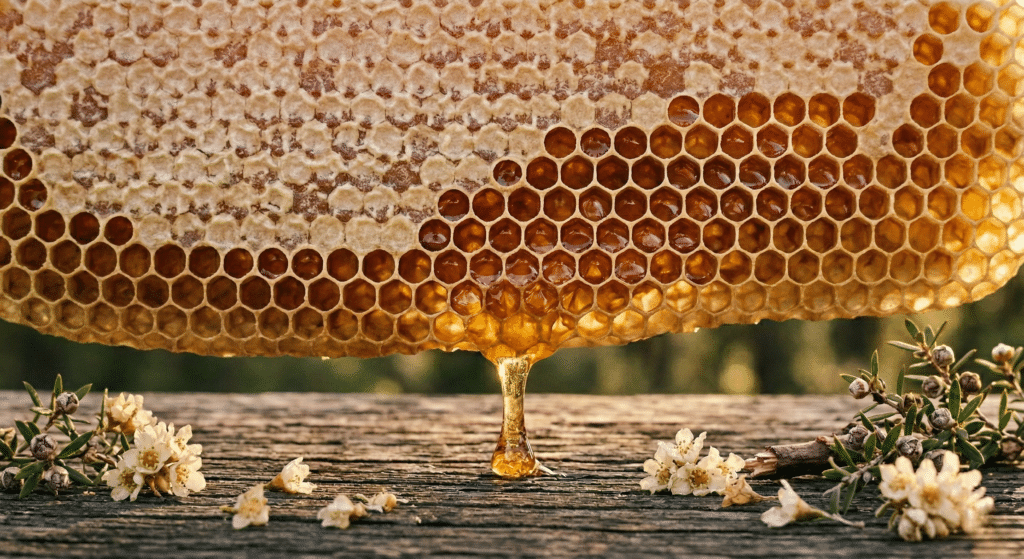
Every Frogmouth Ponds lip balm starts with the same foundation: pure, unrefined beeswax, harvested from our own hives at Port Sorell on Tasmania’s north-west coast. No paraffin. No petroleum. No shortcuts. See exactly how it turns into our natural beeswax lip balm.
If you’ve ever wondered why natural beeswax lip balm feels different from the stuff you grab at the servo counter — thicker, more protective, longer-lasting — the answer starts with what beeswax actually is, and what it does when it meets your skin.
What Is Beeswax, Really?
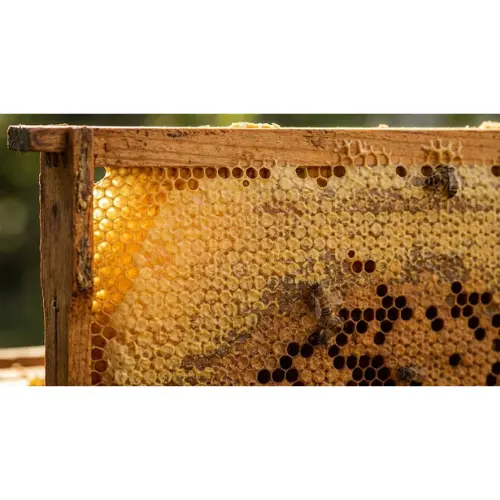
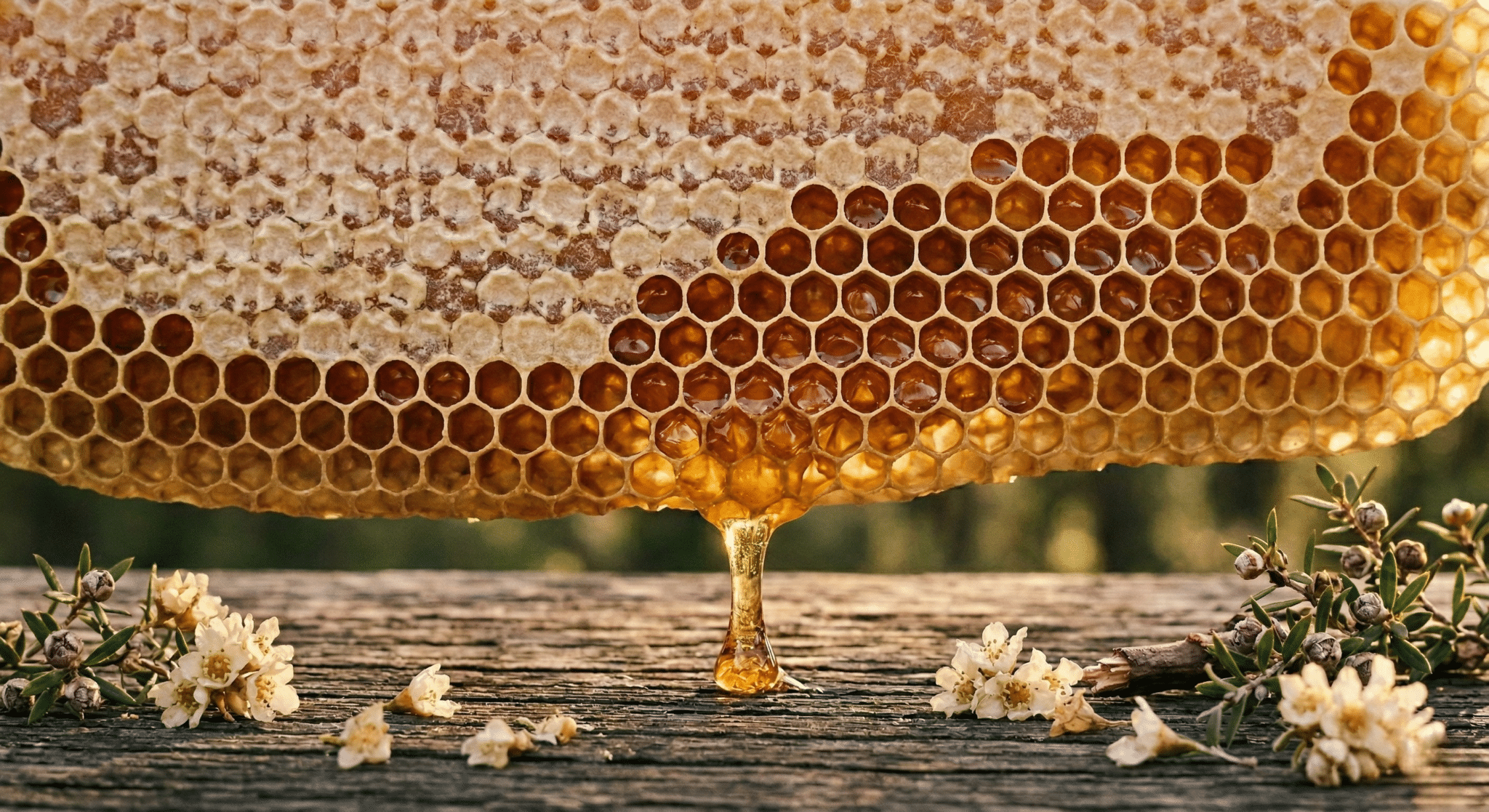
Beeswax is produced by worker honeybees from glands on their abdomen. They use it to build the hexagonal honeycomb cells that store honey and raise brood. It’s one of nature’s most structurally remarkable materials — strong enough to hold kilograms of honey, yet workable at body temperature.
In its raw state, beeswax is a complex mixture of fatty acid esters, long-chain alcohols, and hydrocarbons. That complexity is exactly what makes it so effective in skincare. Unlike paraffin — a petroleum byproduct with a simpler molecular structure — beeswax doesn’t just sit on the skin. It forms a breathable, semi-permeable layer that locks in moisture while still allowing the skin to function naturally.
🐝 Did You Know?
A single hive of bees produces only around 1–2 kg of beeswax per year — compared to 20–30 kg of honey. That’s why genuine beeswax products are inherently small-batch. At Frogmouth Ponds, every gram of wax we use comes from our own hives in Port Sorell and Acacia Hills.
Why Beeswax — Not Petroleum — Belongs on Your Lips
Walk into any supermarket and flip over a cheap lip balm. Somewhere in the ingredients you’ll find petrolatum, mineral oil, or paraffin wax — all petroleum derivatives. They’re cheap, shelf-stable, and effective at forming a barrier. But they’re not doing much beyond that.
Beeswax offers something fundamentally different:
🛡️
Physical Protection
Beeswax creates a durable, waxy barrier that shields lips from wind, cold, and UV exposure — critical for outdoor workers, tradies, and anyone spending time in Tasmania’s variable conditions.
💧
Moisture Retention
Unlike petroleum, beeswax is breathable. It holds moisture in without suffocating the skin — so your lips stay genuinely hydrated, not just coated.
🌿
Natural Vitamin A
Beeswax contains naturally occurring Vitamin A, which supports healthy skin cell turnover. It’s not a medical claim — just a natural bonus from a genuinely natural ingredient.
✅
100% Natural
No petrochemicals. No synthetic preservatives. No parabens. Beeswax is as natural as it gets — and when it’s single-origin Tasmanian, you know exactly where it came from.
Why Tasmanian Beeswax Specifically?
Tasmania’s isolation is its greatest agricultural asset. Our bees forage across clean, pesticide-free pasture and native bushland — Leatherwood forest, coastal scrub, clover paddocks. That purity carries through into the wax they produce.
Tasmanian beeswax has a distinctly clean, faintly floral scent — nothing like the synthetic fragrance added to commercial balms. When you open a tin of Harry Bastard Lip Armour or our Beeswax Lip Balm 3-Pack, that subtle natural scent is the beeswax itself. Nothing added.
Our Beeswax. Our Hives. Our Hands.
We don’t source beeswax from a supplier. Every gram in our lip balms comes from Frogmouth Ponds hives in Port Sorell and Acacia Hills. We render it ourselves, filter it cold, and use it within the same season it’s harvested. That’s what single-origin actually means.
Can Men Use Lip Balm?
Short answer: yes — and they probably should more than they do.
Lips have no sebaceous glands, meaning they produce no natural oil of their own. They’re entirely dependent on the moisture around them, and exposed to everything — wind, sun, salt air, cold. Tradies, farmers, surfers, and anyone working outdoors takes a daily battering on their lips that most people don’t think about until the skin starts cracking.
That’s exactly why we built Harry Bastard Lip Armour the way we did. Higher beeswax concentration for a harder, longer-lasting seal. A matte finish so it’s invisible on the face. A 22g tin that fits in a work shirt pocket. No gloss. No scent. Just serious protection.
Lip balm isn’t a grooming product. It’s PPE for your face.
What Else Goes Into Our Lip Balms?
Beeswax is the foundation, but it doesn’t work alone. Our lip balms are formulated with a small handful of complementary natural oils — each chosen for what it contributes to the final product:
- Shea Butter — deeply conditioning, rich in fatty acids, softens without greasiness
- Avocado Oil — penetrates quickly, supports skin repair, packed with vitamins
- Coconut Oil / Coconut Butter — antimicrobial, emollient, gives the balm a smooth application feel
- Rice Bran Oil — lightweight, fast-absorbing, adds the matte quality to Harry Bastard
- Vitamin E — natural antioxidant and preservative, extends shelf life without synthetics
Seven ingredients total. All natural. All chosen deliberately. We’ll cover each of them in detail in upcoming posts — but for now, beeswax is where the story starts.
Try Our Beeswax Lip Balms
Made in small batches at Port Sorell, Tasmania — with beeswax from our own hives.
Shop Lip Balm 3-Pack
Harry Bastard Lip Armour
S
Stewart Harry
Head beekeeper and founder of Frogmouth Ponds. Accidental skincare formulator. Keeps bees at Port Sorell and Acacia Hills, Tasmania.
Questions about our ingredients or how we make our balms? Get in touch — we’re always happy to talk bees.