What’s Really in Your Lip Balm? How to Read the Label
The Honest Guide · Frogmouth Ponds
What’s Actually in Your Lip Balm?
How to Read the Label — and Why It Matters
Most bestselling lip balms contain ingredients designed to keep you buying more. Here’s how to spot them — and what to look for instead. Start with our natural beeswax lip balm — no mystery ingredients.
By Stewart Harry · Frogmouth Ponds · April 2026 · 7 min read
Grab your lip balm — the one in your bag or your bedside drawer right now — and turn it over. Read the ingredients. If you recognise more than two or three of them without Googling, you’re already ahead of most people. If the list reads like a chemistry experiment, keep reading.
Lip balm is one of those products most of us use daily without ever questioning what’s in it. It’s small. It’s inexpensive. It must be fine. But the ingredients in many bestselling lip balms — including household names — are worth understanding, because some of them actively work against the result you’re trying to achieve.
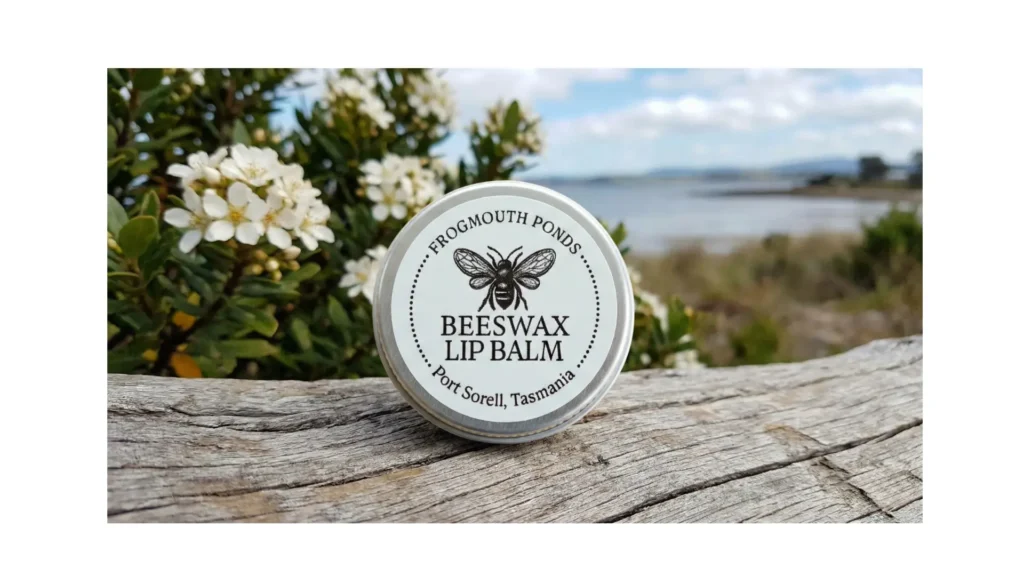
We make our beeswax lip balm on our farm in Port Sorell, Tasmania, using five ingredients we’d be comfortable naming to anyone. That clarity is deliberate. This post explains why we made those choices — and what you should look out for when reading any lip care label.
How to Read a Lip Balm Ingredient Label
In Australia, cosmetic ingredients must be listed in descending order by weight. That means whatever appears first makes up the largest proportion of the product. If “Petrolatum” or “Mineral Oil” is at the top of the list — and in many popular products it is — that ingredient is the backbone of what you’re applying to your lips every day.
Here’s a simplified breakdown of what a typical commercial lip balm label looks like, and how to interpret it:
Typical commercial lip balm — label decoded
-
Avoid
Petrolatum
A petroleum derivative. Occlusive sealant — traps moisture but delivers none. Can create product dependency over time. -
Avoid
Mineral Oil
Another petroleum byproduct. Coats the skin without nourishing it. Concerns exist around impurity levels in cosmetic grade products. -
Caution
Camphor / Menthol
Creates a cooling tingle that feels soothing. Can actually irritate and dry the skin further, creating a sensation loop that encourages re-application. -
Caution
Phenol
An antiseptic sometimes used to temporarily numb irritated skin. Can damage lip tissue with repeated use and is linked to sensitivity reactions. -
Caution
Fragrance / Parfum
A catch-all term that can contain hundreds of unlisted synthetic compounds. Common cause of allergic contact dermatitis on the lip area. -
Caution
Parabens (methylparaben, propylparaben)
Synthetic preservatives. Linked in some studies to hormone disruption. Still common in many cosmetics despite growing consumer pressure to remove them. -
Good
Cera Alba (Beeswax)
Natural wax base. Breathable, emollient, anti-inflammatory. Forms a protective barrier that works with skin rather than against it. -
Good
Butyrospermum Parkii (Shea Butter)
Cold-pressed butter with proven skin conditioning properties. Rich in vitamins A and E. Anti-inflammatory and deeply moisturising. -
Good
Persea Gratissima (Avocado) Oil
Highly penetrating, rich in oleic acid and vitamin E. Supports skin elasticity and accelerates barrier repair. -
Good
Tocopherol (Vitamin E)
A natural antioxidant that protects against free radical damage and acts as a mild natural preservative.
The Petroleum Problem
The most common base ingredient in budget and mid-range lip balms is petrolatum — the same substance as Vaseline. It’s cheap, shelf-stable, and produces an immediately satisfying smooth finish. The marketing language around it has softened over the decades: “moisturising”, “healing”, “protective”. But the reality is more specific than those words suggest.
Petrolatum doesn’t moisturise your lips. It seals them. It forms an impermeable barrier that traps whatever water is already in your skin, which feels good immediately. The problem is what happens next: your skin’s natural ability to retain and regulate moisture is partially suppressed. You reach for the product again. And again.
“Your skin absorbs what you put on it. The thinnest skin on your body is on your lips. The ingredients there aren’t a cosmetic detail — they matter.”
This isn’t a fringe concern. Dermatologists sometimes refer to this pattern as “lip balm addiction” — though the more accurate clinical description is that certain products interfere with the skin’s natural moisturisation mechanism, creating reliance. It’s structurally similar to how some shampoos strip the scalp’s natural oils, causing increased oil production that requires more frequent washing.
The Tingle Problem
Why camphor and menthol can make things worse
Many popular lip balms — particularly those marketed for “healing” dry or cracked lips — contain camphor, menthol, or both. These ingredients create a pronounced cooling sensation that the brain interprets as relief. That sensation is real. The healing, less so.
Both camphor and menthol are counterirritants — they work by stimulating cold receptors in the skin, temporarily masking discomfort. At high concentrations, camphor in particular is a known skin irritant. The cooling effect dissipates, the underlying dryness remains (often worsened by mild irritation), and you apply more product. This cycle isn’t a conspiracy — it’s just chemistry that happens to align with commercial interests.
Natural vs Synthetic: The Real Difference
| Property | Petroleum-based balm | Beeswax-based balm |
|---|---|---|
| Moisture delivery | Seals existing moisture only — delivers none | Delivers active conditioning through oils and butters |
| Skin breathability | Low — creates an occlusive barrier | High — beeswax allows gas exchange at skin level |
| Long-term skin health | Can suppress natural moisturisation over time | Supports and improves natural skin function |
| Ingredient transparency | Often includes “Fragrance” as a catch-all for unlisted compounds | Every ingredient nameable and verifiable |
| Allergy / sensitivity risk | Higher — synthetic fragrances and preservatives are common triggers | Lower — limited ingredients, no synthetic additives |
| Environmental origin | Petroleum refining byproducts | Harvested, cold-pressed, and plant-derived |
What the Good Ingredients Actually Do
Beeswax · Our Base
Cera Alba — Tasmanian Beeswax
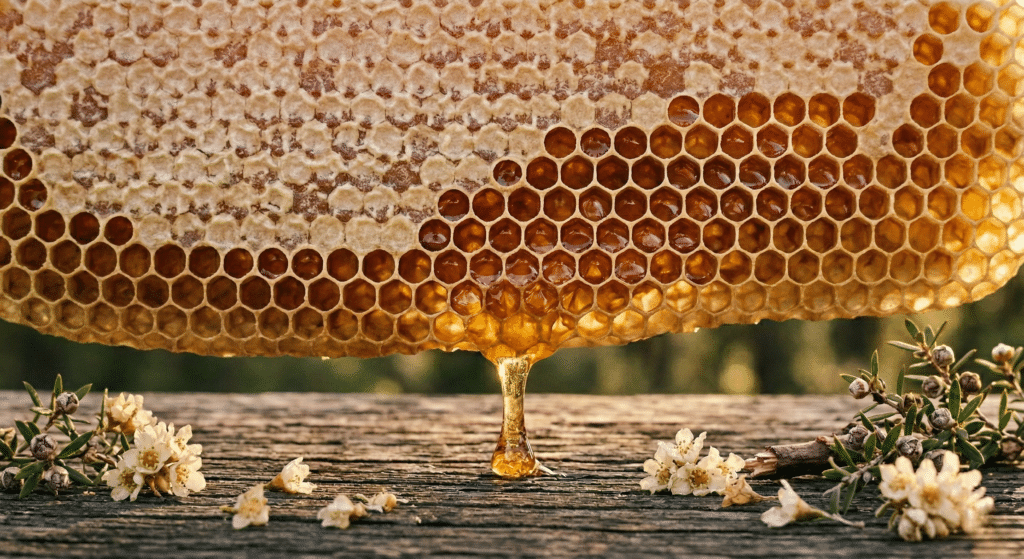
Unlike petroleum, beeswax forms a semi-permeable barrier — it protects without sealing. It contains natural vitamin A, esters, fatty acids, and compounds with documented anti-inflammatory properties. Our beeswax is cold-harvested from our own pesticide-free hives in Port Sorell, Tasmania, in one of the world’s most pristine agricultural environments.
Shea Butter · Conditioning Base
Butyrospermum Parkii
Cold-pressed from the nut of the African shea tree, shea butter is one of the most well-researched natural skin conditioners. Rich in vitamins A and E, oleic and stearic fatty acids. Clinically studied for its anti-inflammatory and wound-healing properties — relevant for cracked or wind-damaged lips.
Avocado Oil · Penetrating Oil
Persea Gratissima
One of the most deeply penetrating plant oils. The molecular weight of oleic acid allows it to pass through the stratum corneum — the outer skin layer — improving elasticity and accelerating barrier repair. Particularly effective for dry, sun-exposed skin.
Coconut Oil · Carrier & Protector
Cocos Nucifera
Medium-chain fatty acids give coconut oil natural antimicrobial and antifungal properties. It adds a clean, non-greasy glide to the balm and helps the other oils absorb without residue. The lauric acid content provides additional barrier support.
Vitamin E · Antioxidant
Tocopherol
Protects the skin from free radical damage from UV, wind, and environmental pollution. Also acts as a natural preservative that extends the shelf life of the oils in the formula — meaning we don’t need synthetic alternatives like parabens or BHT.
What’s in Frogmouth Ponds Lip Balm
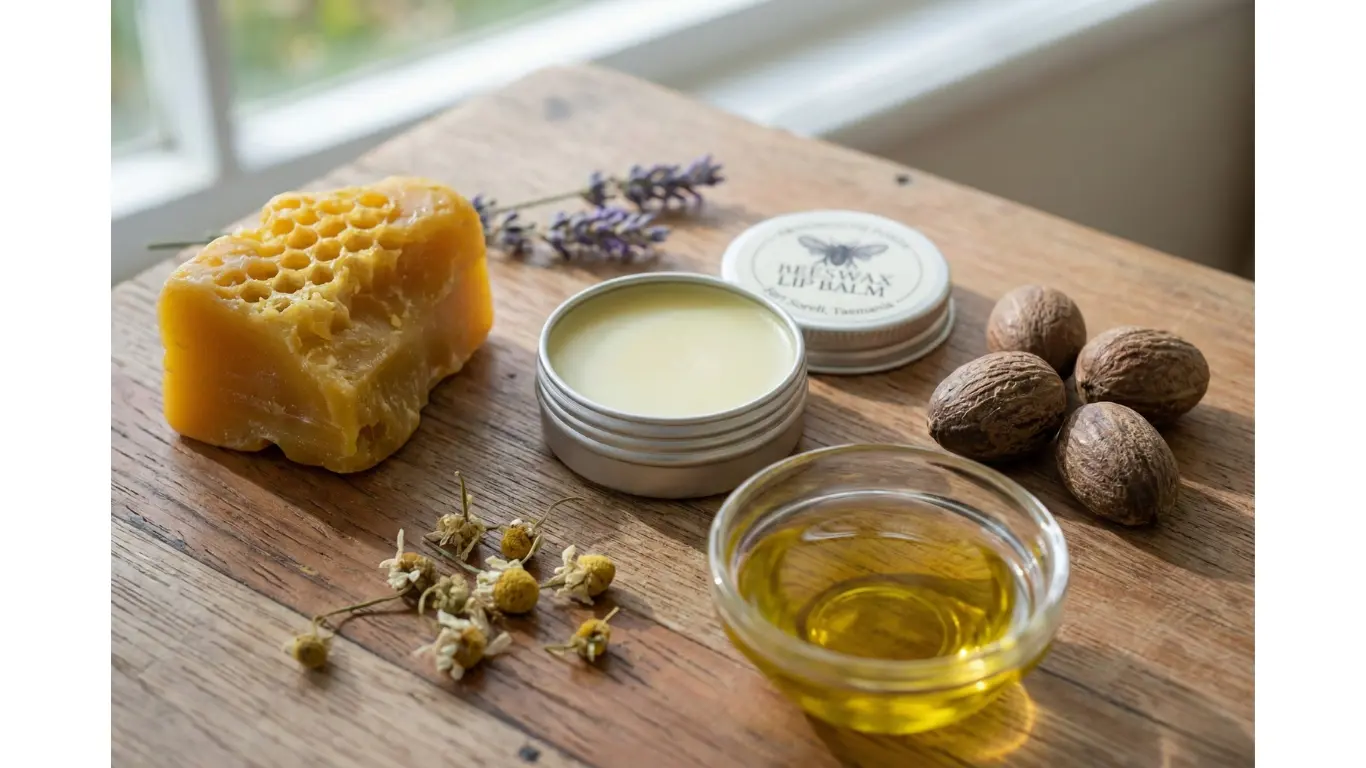
Five ingredients. Nothing hidden. Made on our farm in Port Sorell, Tasmania.
Tasmanian Beeswax
Cold-harvested from our own pesticide-free hives. Single origin, traceable to our apiary.
Shea Butter
Unrefined, cold-pressed. Rich in vitamins A and E, clinically studied skin conditioner.
Avocado Oil
Cold-pressed, high-oleic. Deeply penetrating, improves elasticity and barrier repair.
Coconut Oil
Natural antimicrobial. Adds clean glide and helps other oils absorb without residue.
Vitamin E
Antioxidant protection plus natural preservation — no parabens or synthetics needed.
A Practical Guide to Buying Better Lip Balm
What to check before you buy
-
1
Check the first ingredient. If it’s Petrolatum, Mineral Oil, or White Soft Paraffin, the product is petroleum-based. Not necessarily dangerous, but not genuinely nourishing either. -
2
Look for “Fragrance” or “Parfum” in the list. These are catch-all terms that can include dozens of undisclosed synthetic compounds — common allergy triggers, especially around the lips and mouth. -
3
Count the ingredients. More isn’t always better. A short, readable ingredient list from recognisable sources is a strong quality signal. -
4
Notice whether you’re applying more over time. If you’ve used the same product for months and feel like you need it more, not less, that’s worth paying attention to. -
5
For sensitive skin or kids: avoid anything with camphor, menthol, phenol, or synthetic fragrance. These are the most common lip care irritants for people with reactive skin.
Frequently Asked Questions
Is petroleum jelly (Vaseline) bad for your lips?
It’s not toxic, but it is an occlusive sealant — it traps moisture without delivering any. Used long-term, it can suppress your lips’ natural moisturising response, creating the feeling that you always need it on. It’s also a petroleum refining byproduct, which many people prefer to avoid in personal care products.
Why does my lip balm seem to make my lips drier over time?
This is a well-documented pattern associated with certain ingredients — particularly petrolatum, camphor, menthol, and salicylic acid. Your lips’ natural moisturising mechanism becomes partially dependent on external product rather than self-regulating. Switching to a beeswax-based balm often resolves this within a few weeks, though there may be an adjustment period.
Is beeswax better than synthetic waxes?
For most people, yes. Beeswax contains naturally occurring emollients and anti-inflammatory compounds that synthetic waxes don’t have. Crucially, it forms a breathable barrier — which means your skin can still do its job while being protected. Synthetic waxes and petroleum derivatives tend to be more occlusive and lack the active skin-benefiting properties of natural waxes.
How many ingredients should a good lip balm have?
There’s no magic number, but a short ingredient list from recognisable sources is generally a better sign than a long list of complex chemical names. Our lip balm has five ingredients. We can name and explain every one of them — and so can you, after reading this.
Is Frogmouth Ponds lip balm suitable for children?
Yes — the absence of synthetic fragrances, camphor, menthol, and artificial preservatives makes it suitable for most people including children. The only consideration is a known allergy to bee products or tree nuts (shea). If in doubt, patch test first or check with your GP.
Also from the Apiary
Why One Tin Is Never Enough — The Frogmouth Ponds 3-Pack
The car, the bag, and the bedside table. Stock up properly and never run out again.
Frogmouth Ponds · Port Sorell, Tasmania
Five Ingredients. Nothing Hidden. Farm-Made.
Tasmanian Beeswax, Shea Butter, Avocado Oil, Coconut Oil, and Vitamin E. That’s it. No petroleum, no parabens, no synthetic fragrance. Hand-poured at our Port Sorell apiary.
Shop the 3-Pack — $28 Free Shipping
Save $8 · Free delivery Australia-wide · 21 in stock
S
Written by Stewart Harry
Beekeeper and co-founder of Frogmouth Ponds, based at Port Sorell on Tasmania’s north-west coast. Stewart manages the apiary, oversees all production, and has spent years thinking about what actually belongs in a lip balm — and what doesn’t. Everything Frogmouth Ponds makes starts with those same five questions: what is it, where does it come from, what does it do, is it necessary, and would I use it myself?